|
Immersion
transducers
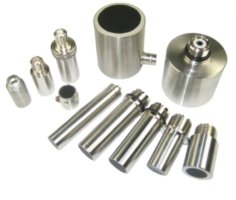
Linear Array Transducers
Applications
Automated high-performance inspection of
submerged parts: metal plates, bars, pipes, composite materials,
forged parts, etc.
Principle & Advantages
The scanned length
(L) is maximised by combining a large number
of elements (typically between 64 to 512) with the widest possible
inter-element pitch (p).
Electronic focusing
can be combined with scanning, for example, to inspect at different
depths. In general, electronic deflection
is little used for this type of application.
- Inspection time is reduced through the
high speed of the electronic scanning combined with a large scanning
width.
- The scanning mechanism is simplified.
Standard Configurations:
Freq.
(MHz) |
Nb elts |
Pitch p
(mm) |
Active size
L x h (mm) |
Housing size
L x W x H
(mm)* |
10 |
64 |
0.5 |
32x10 |
40x16x35 |
10 |
128 |
0.5 |
64x10 |
75x20x40 |
5 |
64 |
1 |
64x15 |
75x20x40 |
5 |
128 |
1 |
128x15 |
140x25x45 |
2.25 |
128 |
1.5 |
192x15 |
205x30x45 |
2.25 |
64 |
2 |
128x20 |
140x30x35 |
General Characteristics
- Frequency from 300 kHz to
20 MHz
- Unlimited number of elements,
typically from 64 to 512
- High sensitivity and signal-to-noise
ratio thanks to the acoustic matching to water
- Good axial resolution and
reduction of the unseen area beneath the surface thanks to a short
pulse length
- Reproducibility of the inspection
because of the homogeneity of the elements of the same probe and
the different probes of the same type
- High reliability over time
thanks to a design that is watertight and resistant to corrosion,
compatible with permanent immersion under 1m of water
Options
Pre-focused
active area (see below)
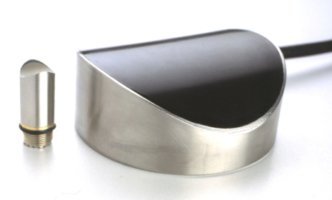
- Housing adapted to the probe
holder
- Low profile and side cable
for wheel probe
- Halogen-free for nuclear
environments
- Customized cabling
- Adaptation to a particular
environment (temperature, pressure, radiation, chemical compatibility)
Mechanical
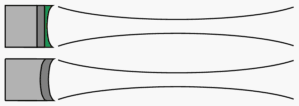
Pre-focusing
On linear arrays, electronic
focusing is possible only in the plane of incidence. However,
in the perpendicular plane (passive aperture), it is possible
to adjust focal depth and lateral resolution by using mechanical
pre-focusing, by choosing the appropriate radius of curvature,
active width (h) and water path.

Flat
array |
pre-focused array with various
radiuses of curvature |
|
|