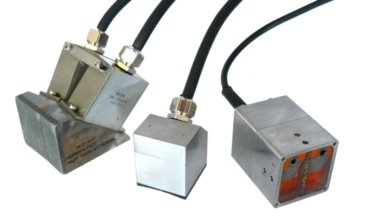
Thanks to the acoustically isolated transmit and reveive transducers, the emitted wave does not interfere with the received wave, allowing a reduced blind zone under the surface, and a better signal to noise ration for the inspection. The angle between transmit and received transducers helps to reduce the level of back scattering echoes.
The transmit and receive transducers can be of various types:
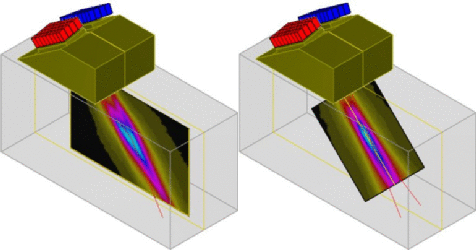 Monolithic : No possible variation on refracted angle and focusing depth.
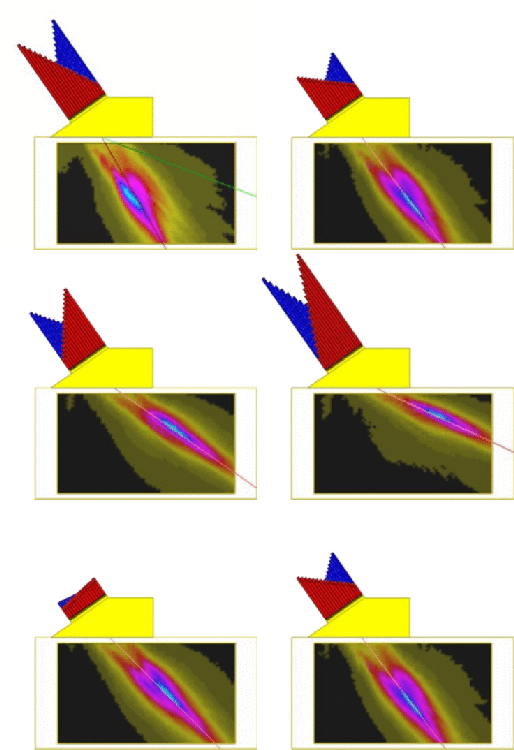 Linear transducers allow a variable refraction angle
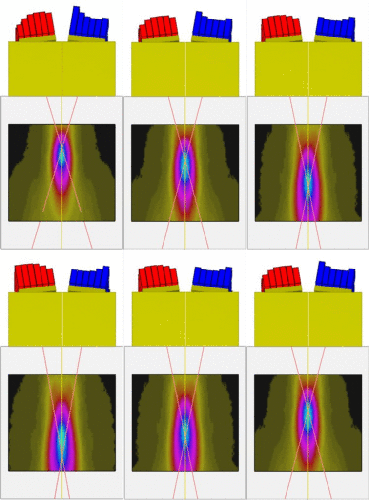 Matrix transducers also allow the beam crossing depth to be varied ...
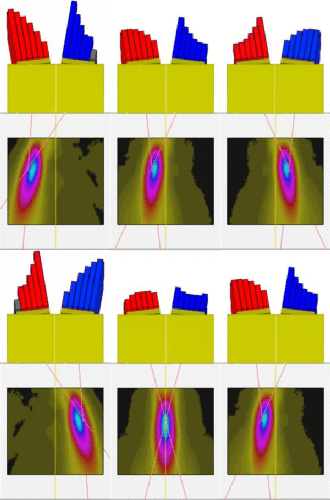 ...and the beam to be deflected laterally
TRL/SE probes can be either integrated or with removable wedge. Both concepts can be used with monolithic, linear or matrix probes
They are dedicated to industrial use with fixed configuration. They are more compact and easy to handle with a scanner, but the wedge angle and transducer position are fixed.
They are more flexible as the wedge geometry and transducers position can be changed by changing the wedge
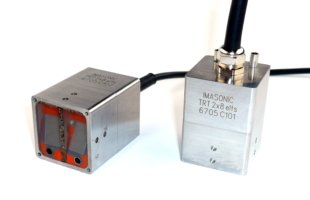
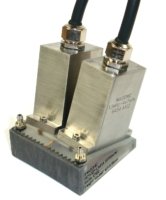
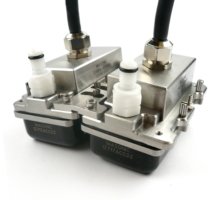
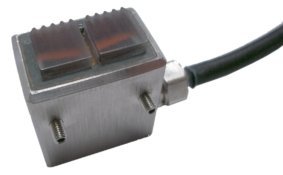 Example of integral TRL phased array probe with water inlets
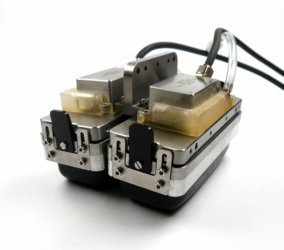 Example of dual matrix TRL probe with conformable wedge
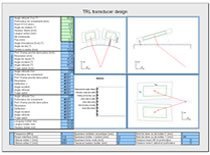
IMASONIC can help you to design your TRL probe, and particularly the incidence angle, roof angle and distance between transmit and receive transducers to reach the targeted focal zone with the desired refracted angle.
We can also simulate in detail the beam crossing area to evaluate the detection and sizing capabilities of the probes.
With the customer’s agreement, IMASONIC can collaborate with partner companies with experience in inspection methods based on TRL probes, to offer already-qualified solutions for various inspections.