|
Phased array probes performances
Transducers key components
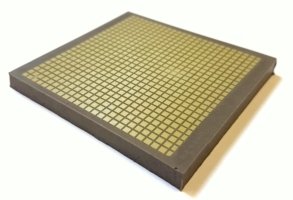
Piezocomposite material
Specially-designed
piezocomposite material is inserted in each type of probe. The composite
components and geometry are defined according to the temporal and
frequency response specifications, while retaining high sensitivity
and signal-to-noise ratio level. For phased array probes, the piezocomposite
material is also designed to lower the cross-coupling between adjoining
elements, which is necessary to properly steer the beam with electronic
delay laws. Typical cross-coupling is lower than –30dB.
More
information >>
Matching layer
Taking into account the conditions of use of the
probe (manual, automated, direct contact, contact with a wedge),
the matching layer is designed to optimize the transfer of energy,
to shorten the pulse length and to be wear-resistant.
Backing material
The backing material is designed to shorten the
pulse length and to attenuate the back echo. Specially-designed
backing materials allow an interesting compromise with high damping
and high attenuation in reduced dimensions.
Housing
The housing is designed to combine the required
geometry with the strength and watertightness of the probe.
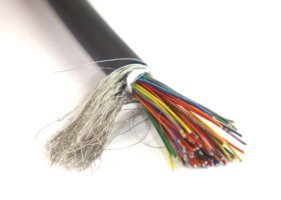
Cable
Performance of the cable is also a key parameter
for the overall performance of the probe. Its attenuation must be
as low as possible, in particular for high frequency probes. Its
electrical impedance is matched with the probe and electronic characteristics.
The bending capability is optimized to access small areas, while
keeping high mechanical resistance and constant electrical properties.
More infrormation >>
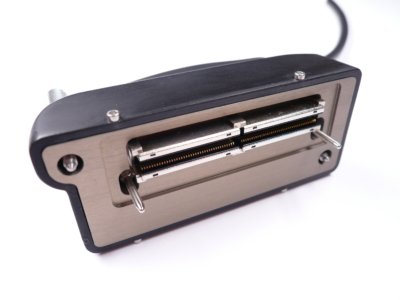
Connector
The connector is most often defined by the electronic
system the transducer will be connected to. However, it must be
adapted to handling and environmental constraints (frequency of
handling, immersion, vibrations, etc), while guaranteeing consistent
quality for the electrical contacts.
More
infrormation >>
Bandwidth or pulse length?
The bandwidth of the probe is generally one
of the main specifications. However, it is often specified
instead of the pulse length.

When the bandwidth has a Gaussian shape, it
is closely linked to the pulse length, and specifying the
bandwidth is enough to get the pulse length. However, when
the shape of the bandwidth is not Gaussian, as it is often
the case, a rather long pulse is obtained, as well as a bandwidth
of more than 100%.
Some applications really require bandwidth,
for example, when the received signal is significantly shifted
to the low frequencies due to the attenuation of the material,
or for harmonic imaging.
Most applications actually require axial resolution
using a short pulse length, and in this case it is more appropriate
to specify the pulse length than the bandwidth.
In addition, the pulse length and bandwidth
largely depend on the driving signal, the electrical impedance
and the environment of the pulsers, which are not easy to
simulate. This is why it is often difficult to predict these
parameters with a high level of accuracy. Imasonic probes
are optimized for and measured with a negative square pulse
with the shortest possible fall time and rise time and a length
of T/2.
|
|