
Homepage    
  Site Map
  Jobs
  Contact us The reference for phased array probes  
  Directions
 

Search Imasonic
Medical
Company
  Performance & Innovation
Projects specifications
Papers
Products
Immersion
Phased Array


>>

Principle
Virtual examples
Design notes for phased array
Probes performances

IMMERSION ARRAYS
Linear arrays
Matrix arrays
Annular arrays
Curved arrays
Daisy arrays
Circular arrays

CONTACT ARRAYS
LInear arrays
Small footprint arrays
Low profile arrays
Matrix arrays
TRL/SE arrays

FLEXIBLE ARRAYS
2D smart flexible arrays
1D smart flexible arrays
Extra flat flexible arrays

ACCESSORIES
Wedges
Cables and connectors

T.O.F.D.
Contact
Special
NDT Applications
Nuclear & power generation
Aeronautics
Metal Industry
Petrochemical
Transportation
Measurement
Application examples


Immersion transducers

Daisy Array Tranducers1

Application

Internal tube and bore inspection
External tube inspection


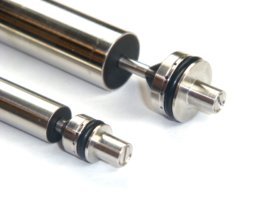
Principle of daisy probe
for inner tube inspection.


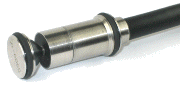
example of daisy probe
with removable mirror


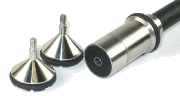
principle and example of
daisy probe outside inspection


Principle

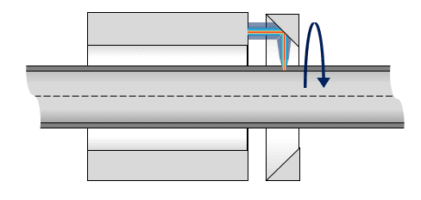
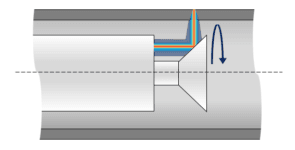
The ultrasonic beam is emitted by a flat circular transducer, which is reflected on the part to be inspected using a mirror.
Electronic scanning allows the beam to be turned through 360°, without rotating the probe or the mirror.
The choice of the angle of the mirror enables the beam to be given a straight or oblique incidence.
General Characteristics:

  • Frequency from 5 to 15 MHz
  • Number of elements: 32 to 256 (according to the tube diameter)
  • Minimum internal tube diameter (for internal probes): 15 mm
  • High sensitivity and signal-to-noise ratio, thanks to the acoustic matching to water that allows a very good transfer of acoustic energy
  • Good axial resolution, and reduction of the unseen area below the surface thanks to a short pulse length
  • Reproducibility of the inspection through the homogeneity of performance between the elements of the same probe, and between different probes of the same type.

Options

  • Centring device
  • Water input device
  • Mechanical interfacing with the pusher-puller
  • Customized connection
  • Adaptation to a particular environment (temperature, pressure, radiation, chemical compatibility).


  Top of this page
© 2002 Imasonic S.A.