
Homepage    
  Site Map
  Jobs
  Contact us The reference for phased array probes  
  Directions
 

Search Imasonic
Medical
Company
  Performance & Innovation
Projects specifications
Papers
Products
Immersion
Phased Array


>>

Principle
Virtual examples
Design notes for phased array
Probes performances

IMMERSION ARRAYS
Linear arrays
Matrix arrays
Annular arrays
Curved arrays
Daisy arrays
Circular arrays

CONTACT ARRAYS
LInear arrays
Small footprint arrays
Low profile arrays
Matrix arrays
TRL/SE arrays

FLEXIBLE ARRAYS
2D smart flexible arrays
1D smart flexible arrays
Extra flat flexible arrays

ACCESSORIES
Wedges
Cables and connectors

T.O.F.D.
Contact
Special
NDT Applications
Nuclear & power generation
Aeronautics
Metal Industry
Petrochemical
Transportation
Measurement
Application examples


Immersion transducers

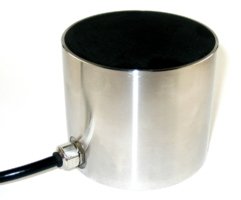
High resolution matrix Array Transducers

see also contact matrix arrays which configuration can be extrapolated to immersion arrays

1

Applications

Inspection of thick parts, forged parts, complex interface parts and difficult materials (coarse grain, non homogeneous).

Principle & Advantages

The shaping of the active surface in a 2D array allows a 3D beam steering and 3D correction of the focus, which can compensate, for example, for the defocusing effect of a complex interface or an anisotropic material.
Furthermore, matrix immersion transducers, like annular arrays, allow electronic focusing at different depths.

Matrix arrays with small pitch can also be used to steer the beam in 3D. These arrays are describes in the contact matrix arrays page as it is their most common way of use. However they can easily be adapted to immersion.

General Characteristics

  • Frequency from 300 kHz to 20 MHz
  • Number of elements: from 32 to 1024
  • High sensitivity and signal-to-noise ratio, thanks to the acoustic matching to water allowing a very good transfer of acoustic energy
  • Good axial resolution, and reduction of the unseen area below the surface thanks to a short pulse length
  • High reliability over time thanks to a design that is watertight and resistant to corrosion, compatible with permanent immersion under 1 m of water

Standard configurations

Freq. (MHz)
Nb elts
Active diameter
Housing size
diameter x height (mm)*
10
128
40
50 x 60
7.5
128
50
60 x 60
5
128
60
70 x 60
2.25
128
80
90 x 60

Options

  • Fermat surface pre-focusing
  • Spherical or bifocal mechanical pre-focusing
  • Housing adapted to the probe holder
  • Halogen-free for nuclear environments
  • Customized cabling
  • Adaptation to a particular environment (temperature, pressure, radiation, chemical compatibility).


Time Reversal Mirror Technique

Matrix arrays can be used with time reversal mirror technique (M Fink).
This patented technique using two successive shots allows significant signal to noise ratio improvements by compensating the material anisotropy.


  Top of this page
© 2002 Imasonic S.A.