The principle of phased array technology is to activatefor each shot all or some of the transducer elements which, with the adapted delay laws, contribute collectively to the generation of the beam.
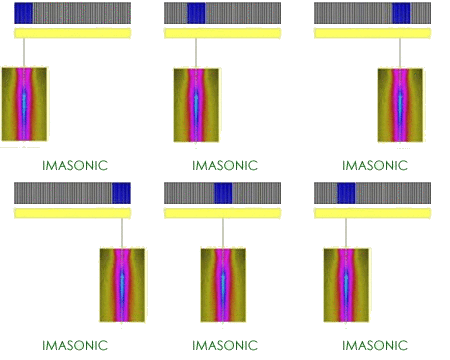
Electronic Scanning
The beam is electronnaly translated by alternatively firing a given number of elemnts of a linear or circula phased array transducer.
This technique is an alternative to the mechanical translation of a single element probe.
Advantages
- Faster inspection
- No mechanical movement required, or reduction of scanline number
- Possibility of combining with electronic focusing and beam steering
Electronic focusing
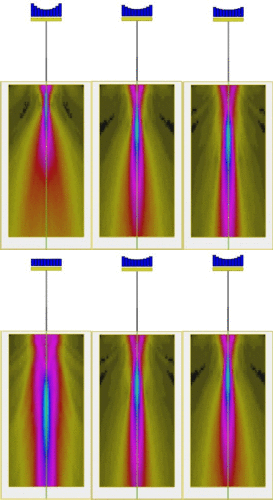
The beam is electronically focused by applying symmetrical delay laws to the different elements of a linear or annular phased array transucer.
This technique is an alternative to using several transducers to focusat different depths.
Advantages
- Only one probe for focusing at each depth
- Thanks to dynamic focusing the inspection of thick pieces can be make faster.
- Electronic focusing can compensate for focusing aberrations due to refraction at interfaces.
Electronic steering
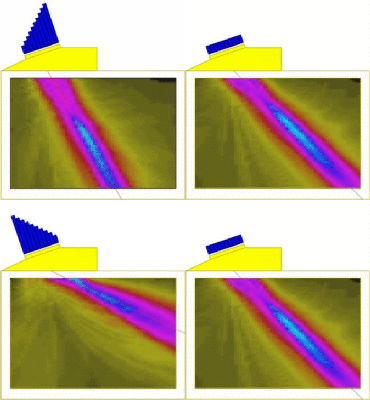
The beam is electronicaly deflected by applying delay laws to different elements of a linear, circular or matrix array. Linear and circular arrays allow for 2D beam steering, while matrix arrays allow for 3D steering.
This technique is an alternative to using several transducers at different angles.
Advantages
- Only one transducer is required for inspection at variable angles
- Faster inspection of parts with complex geometry
- This technique can be combined with electronic focusing
Full Parallel
All the elements of the transducer are activated for each slot, with or without delay low, to insonify a whole cut of the inspected part, or to concentrate the energy in a selected area.
Reception also takes place using all the elements of the transducer. An advanced treatment in thenundertaken electronically to build an image of the part in the incidence plane of the transducer.
This technique has the advantage of being very fast, as it requires only one ultrasonic shot to inspect a cut, whereas cenventionnal phased array technology requires linear, circular or angular scanning, each requiring ultrasoni shots.