|
Design notes for linear phased array probes
Grating lobes
When using a phased array transducer, delay laws
are applied to each channel to generate a beam with a given refraction
angle and focal distance. The ultrasonic beam is generated by the
constructive interference of each transducer element’s contribution
in the desired direction. See
phased array principle here >>
In some cases, this interference can also be constructive
in other directions. These lobes of energy emitted outside the electronically
driven direction are called grating lobes.
These energy lobes can interact with the part to be inspected in
the same way as the main beam, and thus generate echoes causing
interference to the inspection. Therefore they have to be avoided
as much as possible.
The angle of the position of grating lobes in relation
to the main beam is given by the following formula
sin
qk = k . l /
p - sin q
q = refracted
angle of the main beam
qk = refracted angle of the grating lobe
k (k: integer)
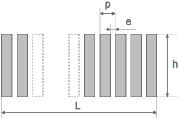
P = inter-element pitch (p) of the linear transducer
l = wavelength in the medium under consideration
Note: this formula is only valid in the case of
electronic deflection (linear delay law) . In case of electronic
focusing, the angular deviation between the main beam and the grating
lobes is reduced.
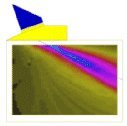
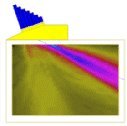
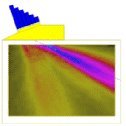
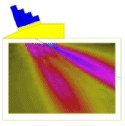
Example for 70°SW in steel
 |
| p <
l/2, no grating lobe |
p =
l, low level
grating lobe |
p =
1,6.l |
p =
2.l, high level
grating lobe |
From the above formula, the following general rule
can be obtained :
- If p < l/2, then no grating lobe
is generated whatever the angle of the main beam.
- If p > l, then there is always at
least one grating lobe generated whatever the angle of the main
beam.
-Between these two values, the grating lobes appear progressively
according to the angle of the main beam. The maximum pitch to avoid
grating lobe is given by the formula:
p < l
/ (1 + sin q)
In practice, for typical use in the 30-70° SW
or LW range with a wedge for a 45° angle, a pitch of 1.0 λ
gives good results.
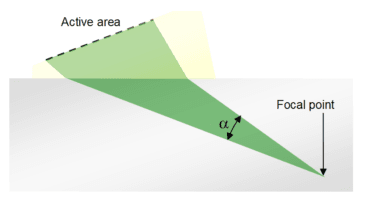
Lateral resolution along the plane of incidence
The following formula allows a good approximation
to be made of the lateral resolution, and allows the correlation
between the active aperture and the lateral resolution to be rapidly
checked
W
= 0.44.l / sin ( a
/ 2)
W= focal spot or beam width (at –6dB in emission
reception)
l = wave length in the medium under consideration
a = angle beneath which the active area
is seen from the focal point
Note: This formula is a rough estimate when the
hypothesis of electronic focusing at the focal point under consideration
is made. It does not take into account the energy refraction/reflection
law depending on the angle.
Number of elements
Knowing the inter-element spacing required to avoid
grating lobes, and the width of the active aperture, the number
of elements necessary can be rapidly deduced.
If the appropriate number of electronic channels is not available
for technical or economic reasons, the best possible compromise
must be found, by readjusting the inter-element spacing, the frequency,
and/or the active aperture (and thus the lateral resolution)
Note: Some linear array sensors are also used for
electronic scanning. In this case, the beam is generated by only
some of the elements. To calculate the lateral resolution, only
the size of the active area is to be taken into account.
|