Homepage    
  Site Map
  Jobs
  Contact us The reference for phased array probes  
  Directions
 

Search Imasonic
Medical
Company
  Performance & Innovation
Projects specifications
Papers
Products
Immersion
Phased Array


>>

Principle
Virtual examples
Design notes for phased array
Probes performances

IMMERSION ARRAYS
Linear arrays
Matrix arrays
Annular arrays
Curved arrays
Daisy arrays
Circular arrays

CONTACT ARRAYS
LInear arrays
Small footprint arrays
Low profile arrays
Matrix arrays
TRL/SE arrays

FLEXIBLE ARRAYS
2D smart flexible arrays
1D smart flexible arrays
Extra flat flexible arrays

ACCESSORIES
Wedges
Cables and connectors

T.O.F.D.
Contact
Special
NDT Applications
Nuclear & power generation
Aeronautics
Metal Industry
Petrochemical
Transportation
Measurement
Application examples


Immersion transducers

Curved Linear Array

1


Curved arrays for tubes & bars inspection

1


Curved arrays for composite stengtheners inspection

Applications

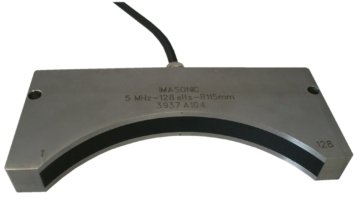
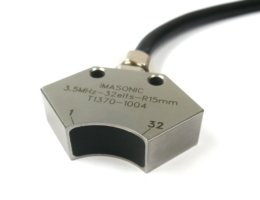
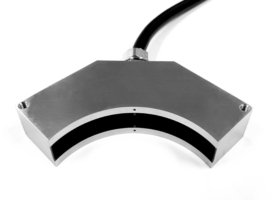
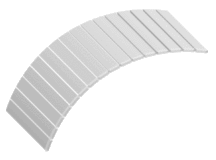
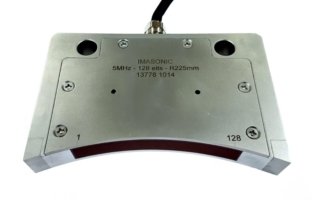
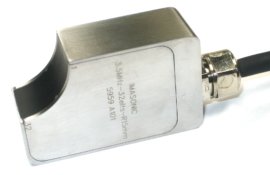
These transducers are an adaptation of flat linear arrays for the inspection of parts with circular symmetry. The linear scanning becomes circular to adapt to inspection of tubes, bars or sections.

  • Tubes & bars inspection
  • Aircrafts composite strengtheners inspection

Principle

360° or sector electronic beam scanning is combined with electronic focusing and beam steering.

  • Scanning speed can be adapted to the water path.
  • Focusing depth and inspection angle can be
    electronically selected depending on the tube/bar
    configuration.

General Characteristics

  • Frequency from 1 MHz to 20 MHz
  • Number of elements unlimited, typically 64 to 512
  • High sensitivity and signal-to-noise ratio, thanks to the acoustic matching to water that allows a very good transfer of acoustic energy.
  • Good axial resolution, and reduction of the unseen area below the surface thanks to a short pulse length
  • Reproducibility of the inspection through the homogeneity of performance between the elements of the same probe, and between different probes
    of the same type
  • High reliability over time thanks to a watertight and corrosion-resistant design, compatible with permanent immersion under one metre of water in aggresive industrial environments.

Standard Configuration

Actually there is no standard configuration!
The frequency, the number of elements, the spacing and the radius of curvature are defined according to the tubes, bars or sections to be inspected, the defects to be detected and the desired inspection speed in particular.
Options

  • Pre-focused active area (See Page 23)
  • Housing adapted to the probe holder
  • Customized cabling
  • Adaptation to a particular environment (temperature, pressure, radiation, chemical compatibility)

A single circle or multiple sectors?

1

1

1


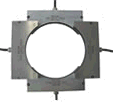
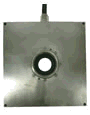
For 360° inspection of tubes or bars, either a single encircling probe or an arrangement of several probes each covering a sector, typically 45° to 90°, can be considered.
Both possibilities offer various advantages and disadvantages.

The sectorial probes require a certain overlap for a homogeneous inspection of the whole circumference. They must therefore be placed in at least two rows, which requires greater axial space. Because of the necessary overlap, a greater total number of electronic channels are also required.

A single probe has the advantage of needing less space, and of optimizing the number of useful channels since no overlap is needed.

The inspection of bars or tubes often requires the use of several simultaneous
beams on the same circumference. In the case of a single probe, the
reflexions of a beam may cause interference to the inspection with other
beams. Arranging the probes over several rows enables this effect to be
limited where necessary.

Finally, while the purchase price of each option is not very different, the maintenance
cost of the sectional curved probes is markedly lower, as only part of the circumference
can be replaced.


  Top of this page
© 2002 Imasonic S.A.